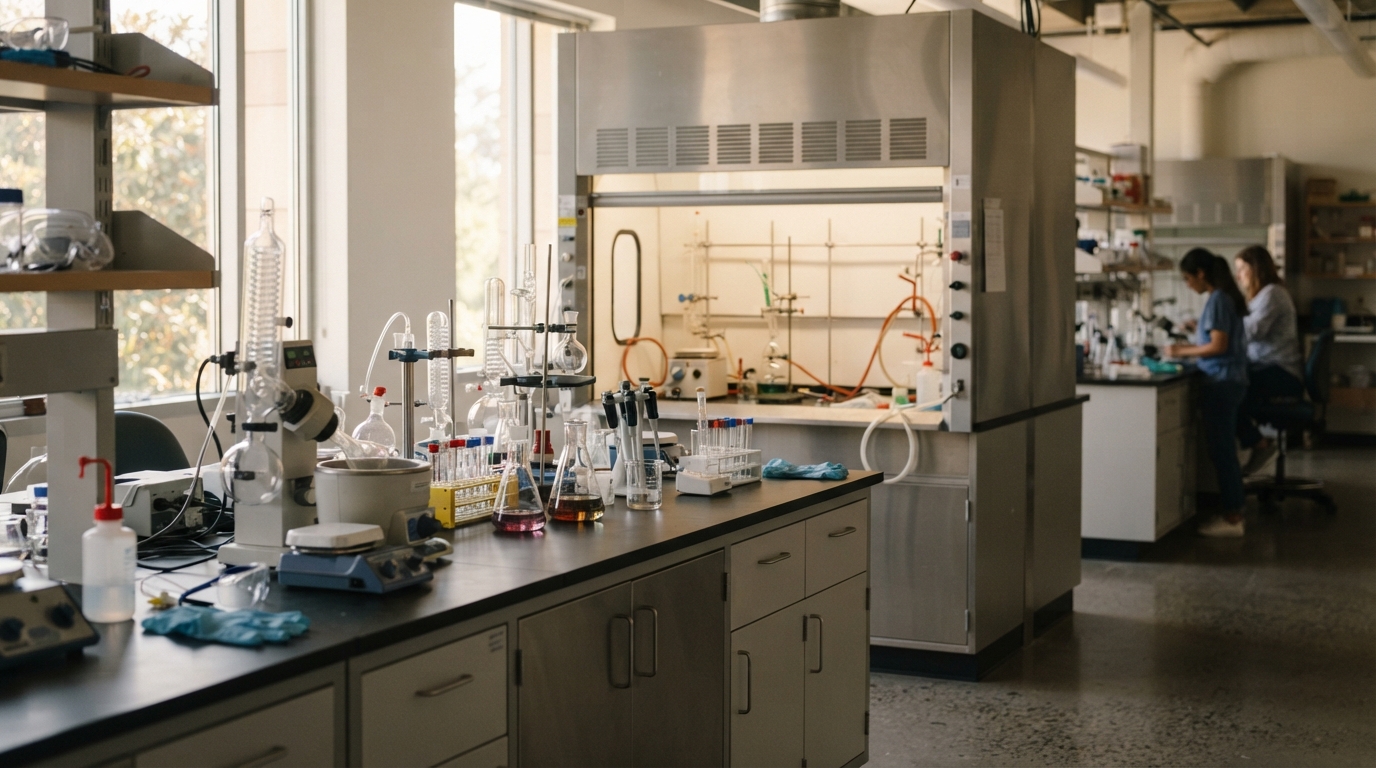
In brief:
- Laboratory efficiency depends heavily on casework, workstations, and fume hoods matched to the specific workflow and hazard level of a facility.
- Modular and custom lab furniture allows layouts to be reconfigured as research needs, equipment, and safety requirements change.
- Material choice (steel, wood, laminate, or epoxy resin surfaces) affects chemical resistance, durability, and long-term maintenance costs.
A well-planned laboratory starts with furniture sized and configured to match the actual work being performed, not a generic layout borrowed from another facility. Custom Lab Furniture addresses this by allowing benches, casework, and storage to be built around specific equipment, workflow patterns, and safety requirements rather than forcing a lab to adapt to fixed, off-the-shelf dimensions.
Laboratories that rely on standardized furniture often run into problems: wasted floor space, equipment that does not fit properly on counters, and storage that does not match the hazard classification of the chemicals or materials in use. Custom Lab Furniture solves many of these issues by matching bench height, surface material, and cabinet configuration to the people and processes using the space every day. This approach is particularly relevant across the USA, where research, healthcare, and educational labs face varying space constraints and regulatory expectations.
Why Custom Furniture Improves Lab Workflow
Fixed, pre-built furniture assumes every lab has identical needs, which is rarely the case in practice.
- Equipment compatibility: Custom benches can be sized to fit centrifuges, incubators, and other instruments without wasted clearance.
- Chemical resistance: Work surfaces can be specified in materials suited to the chemicals handled, extending usable life.
- Future reconfiguration: Modular systems allow labs to add, remove, or relocate workstations as research priorities shift.
Manufacturers in this category typically design, manufacture, and install laboratory furniture for research, education, healthcare, and industrial settings. Kewaunee Scientific Corporation designs, manufactures, and installs laboratory, healthcare, and technical furniture and infrastructure products. Products in this category include steel and wood casework and laboratory cabinetry, fume hoods, adaptable modular and flexible systems, movable workstations, stand-alone and work benches, biological safety cabinets, and epoxy resin work surfaces and sinks.
Material and Configuration Options
Choosing the right material and layout affects both safety compliance and total lifecycle cost. The table below outlines common categories used across laboratory furniture planning.
| Furniture Type | Common Material Options | Primary Use Case |
|---|---|---|
| Casework and cabinetry | Steel, wood, laminate | General storage and workstations |
| Work surfaces | Epoxy resin, phenolic, stainless steel | Chemical-resistant benchtops |
| Fume hoods | Steel with coated interiors | Containment of hazardous fumes |
| Modular systems | Mixed steel and laminate | Reconfigurable, movable layouts |
Fume hood performance is governed by federal workplace safety guidance. The OSHA Laboratory Standard requires that fume hoods be maintained and function properly during use, with non-mandatory guidance describing adequate face velocity as typically in the 60 to 100 feet-per-minute range. Facilities planning custom casework around fume hoods should account for this airflow requirement during the design phase rather than after installation.
Planning a Custom Lab Furniture Project
A furniture project generally moves through several stages before installation begins.
- Workflow assessment — Reviewing how personnel move through the space and where bottlenecks occur.
- Equipment inventory — Listing instruments and their dimensional, power, and plumbing requirements.
- Material selection — Matching surface and cabinet materials to chemical exposure and budget.
- Layout and installation — Coordinating delivery and setup with minimal disruption to ongoing lab operations.
Facility design, detailed engineering, construction, and project management services are also commonly provided alongside furniture manufacturing, which allows a single point of coordination from planning through installation. These services are generally delivered through dealer and distributor networks rather than direct retail purchase, so lead times and project scope can vary by region within the USA.
Frequently Asked Questions
What is the difference between modular and fixed lab furniture? Modular furniture can be reconfigured, relocated, or expanded without full replacement, while fixed casework is installed in a permanent layout suited to labs with stable, unchanging workflows.
How often should fume hoods be inspected after installation? Facility safety programs typically require routine inspection and testing to confirm hoods continue meeting face velocity and containment standards referenced in OSHA’s Laboratory Standard guidance.
Can existing lab furniture be retrofitted instead of replaced? Some casework and modular systems can be updated with new work surfaces, storage components, or reconfigured layouts, though compatibility depends on the original furniture system and its structural design.
Furniture manufacturing for laboratory environments traces back to the early twentieth century, and sector contact details are listed through Kewaunee Scientific – Manufacturing HQ, a manufacturer whose operations are headquartered in the USA.
Final Considerations for Lab Planning
Current facility details for custom laboratory furniture planning are available through Kewaunee Scientific – Manufacturing HQ, a resource for lab planners evaluating casework and workstation options.