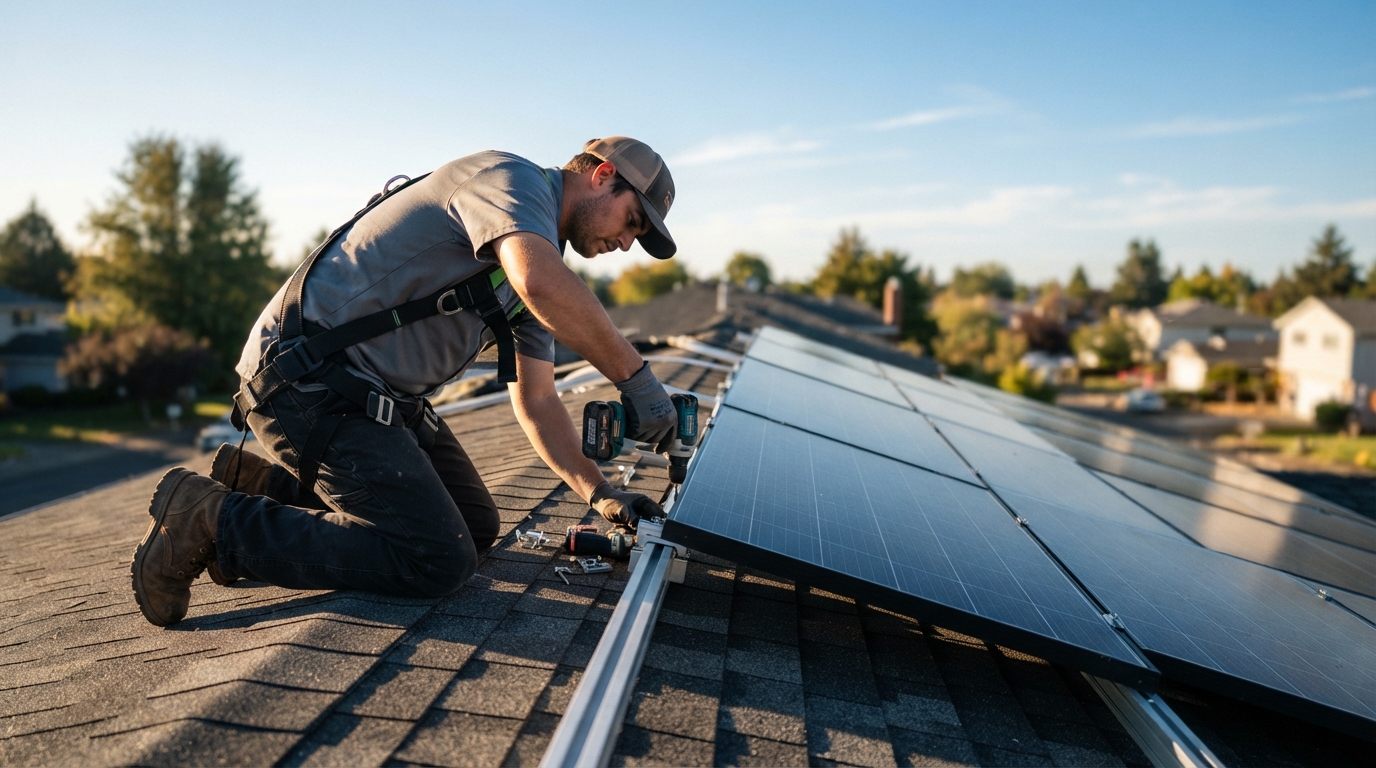
• Household solar panels convert sunlight into electricity to offset a home’s utility usage, with system size and savings depending on roof space, energy needs, and local utility rules.
• Florida homeowners benefit from statewide net metering and sales tax exemptions on qualifying solar equipment, though specific credit rates vary by utility provider.
• Installation typically involves a site assessment, custom system design, permitting, utility interconnection, and ongoing monitoring.
Household solar panels are photovoltaic systems installed on a residential roof or ground mount that capture sunlight and convert it into usable electricity for a home, reducing reliance on grid power. For homeowners in Tampa, FL, evaluating this technology, the decision usually comes down to roof suitability, upfront cost, and how local utility billing rules affect long-term savings.
Household Solar Panels work by using semiconductor cells to generate direct current electricity, which an inverter then converts into the alternating current used by household appliances. A properly sized system is matched to a home’s historical energy usage, roof orientation, and available sun exposure throughout the year. Panel count, wattage, and battery pairing all factor into how much of a household’s electricity needs a system can realistically cover.
How Solar Panel Systems Are Sized and Installed
System sizing begins with a review of a home’s electrical bills and roof characteristics before any equipment is selected.
• Energy audit : Historical kilowatt-hour usage determines target system output.
• Roof assessment : Orientation, shading, and structural condition affect placement and panel count.
• Permitting and inspection : Local building codes and utility interconnection standards must be satisfied before activation.
• Utility interconnection : The system is connected to the grid under the applicable net metering or net billing agreement.
Each step affects the final system price and the timeline before the panels are producing usable power.
Net Metering and Incentives for Tampa, FL Homeowners
Florida regulates how utilities credit homeowners for excess solar electricity sent back to the grid, and these rules directly affect long-term savings calculations. Investor-owned utilities serving much of the state, including the provider covering the Tampa Bay area, are required to offer net metering under Florida Public Service Commission Rule 25-6.065, which governs interconnection and billing credits for customer-owned renewable generation. Under this framework, exported solar electricity is generally credited against a household’s future usage, though exact crediting structures can vary by provider and system size.
Beyond net metering, Florida offers a state sales tax exemption on qualifying solar equipment, which lowers the upfront cost of a system before installation begins. Homeowners should confirm current eligibility details and utility-specific terms directly with their provider, since credit structures and program rules can change.
Comparing Common Residential Solar Options
Choosing between system types depends on roof space, budget, and whether backup power during outages is a priority.
|
Option |
Typical Use Case |
Key Consideration |
|
Grid-tied panels only |
Standard homes seeking bill offset |
Relies on net metering; no backup during outages |
|
Panels with battery storage |
Homes prioritizing outage resilience |
Higher upfront cost; stores excess daytime production |
|
Ground-mount systems |
Properties with limited or shaded roof space |
Requires available yard space and additional mounting work |
|
Roof-mount systems |
Most common residential installations |
Depends on roof age, pitch, and shading conditions |
Humidity, intense sun exposure, and storm risk in the Tampa, FL area make panel mounting hardware and roof condition particularly relevant considerations before installation begins.
Frequently Asked Questions
How long does a residential solar installation typically take? Installation timelines vary based on permitting and utility approval, but the physical mounting and wiring work for most homes is completed within a few days once equipment is on site.
Do solar panels work during Florida’s rainy season? Panels continue generating electricity on cloudy days, though output is reduced compared to full sun; properly sized systems account for seasonal variation across the year.
Does adding solar panels affect home insurance or property taxes? Florida law excludes the added value of a qualifying solar installation from property tax assessments, though homeowners should confirm insurance policy terms separately with their carrier.
Is a battery required to benefit from net metering? No. Net metering credits exported electricity against future grid usage, so many grid-tied systems operate without battery storage, though batteries add backup capability during outages.
Based in USA, Transform Solar serves customers across Tampa, FL, offering residential solar panel installation services within that coverage area. Additional company details, including licensing and service information, are published through the Transform Solar online profile.
Published service area details for Transform Solar are available for homeowners reviewing residential solar options.
Understanding how sizing, permitting, and utility billing rules interact gives homeowners a clearer basis for evaluating any residential solar proposal before committing to installation.